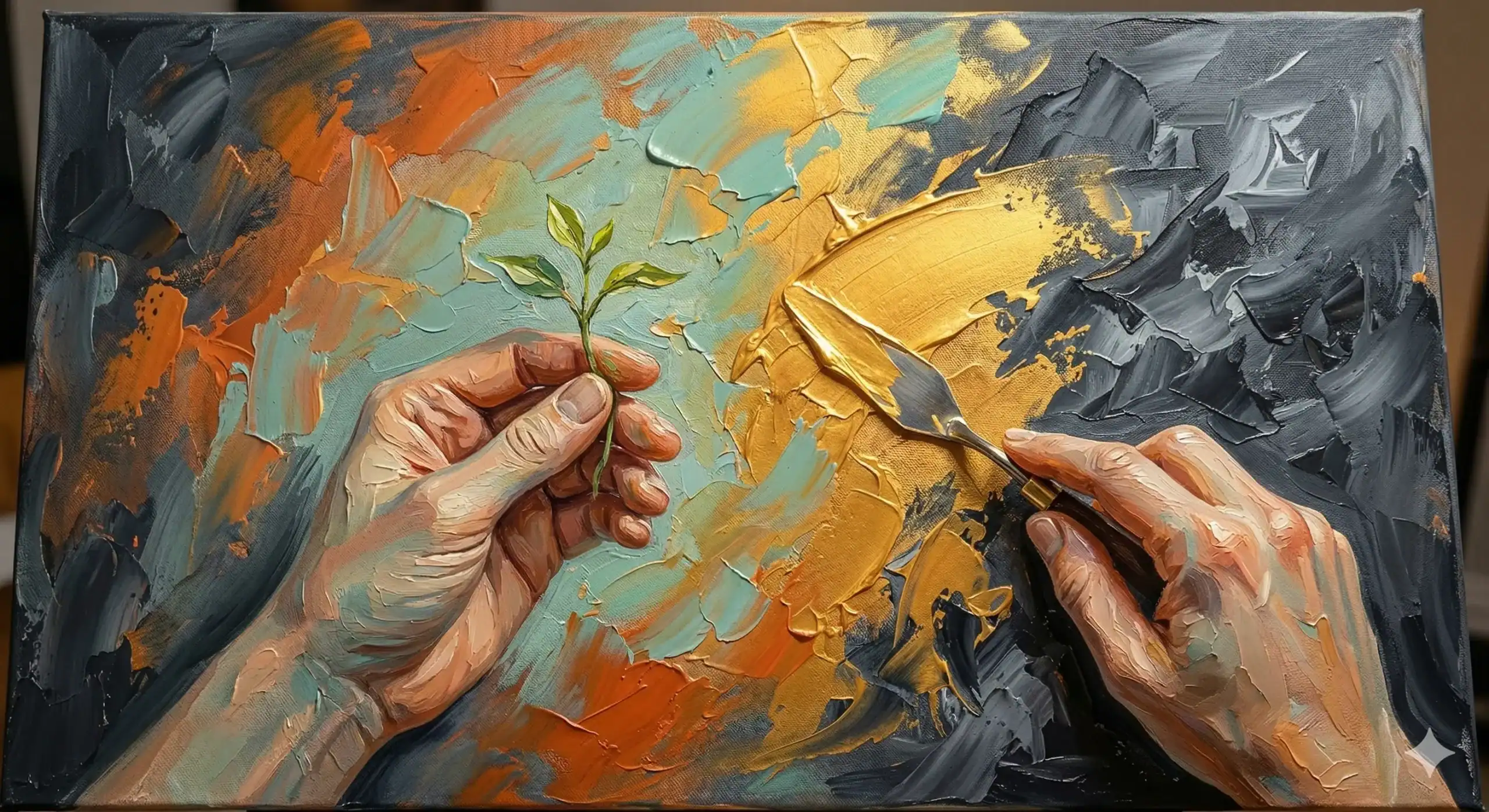
Introduction: The Paradox of the Human Spirit
By 2026, the world has become a mirror of the human psyche, reflecting both our greatest triumphs of cooperation and our most devastating impulses toward discord. We find ourselves at a historical crossroads where the “unplugged” movement is no longer just about digital wellness – it is about choosing which side of human nature we will inhabit.
Why is it that, in the same office or neighborhood, one person finds purpose in the slow, meticulous harmony of palette knife painting or community building, while another is consumed by the “frenzy” of online conflict, seeking to undermine, attack, or cause distress? To understand this, we must look past the surface-level politics and delve into the deep architecture of the brain, the echoes of our evolutionary past, and the specific “distraction traps” of the 21st century.
1. The Neurobiology of the “Harm-Seeker”
The impulse to do harm – whether it is physical, emotional, or digital – is rarely a sign of strength. Biologically, it is almost always a sign of a nervous system that is trapped in a state of chronic defensiveness.
The Amygdala Overdrive
The human brain’s primary goal is survival. When an individual’s early environment or current lifestyle (excessive news, social media vitriol) keeps them in a state of high alert, the amygdala becomes hyper-reactive. In this state, the brain views “the other” as a threat to be neutralised rather than a collaborator to be understood.
- The Empathy Shut-Down: When the amygdala is in charge, the prefrontal cortex – the part of the brain responsible for higher-order reasoning and empathy – effectively “goes offline.” This is known as the Amygdala Hijack.
- Research Insight: A landmark study from Social Cognitive and Affective Neuroscience (2024) utilised fMRI scans to show that individuals with chronic “digital stress” exhibited a significant thinning of the anterior insula. This is the neurological bridge that allows us to mirror and feel the pain of others. When this bridge is weakened, doing harm becomes emotionally “frictionless.”
The Dopamine of Discord
For many who seek to do harm or cause distress online, the act becomes addictive. Anger releases adrenaline and dopamine. This creates a powerful, if toxic, sense of “purpose” and “control.”
2. The Architecture of Harmony: Why We Cooperate
If the path to harm is paved with fear, the path to harmony is paved with biological resilience. Humans are not “naturally” peaceful, but we are “obligately” social. Our survival depended on our ability to live in harmony.
The Oxytocin Advantage
Harmony-seekers often exhibit a more regulated vagus nerve, the main component of the parasympathetic nervous system. When we engage in pro-social behaviours – teaching a colleague a new skill, gardening, or practicing the “unplugged” arts – our brain rewards us with oxytocin.
- The Health Bonus: Research from The Harvard Study of Adult Development (the longest-running study on human health) shows that those who cultivate harmony in their relationships have lower levels of systemic inflammation and live up to 10 years longer than those in chronic conflict.
The “Collective Effervescence”
A term coined by sociologist Émile Durkheim, this describes the feeling of belonging to something larger than oneself. Harmony-seekers find this in physical spaces – the production line, the office, the studio – where synchronised human effort creates a sense of profound calm that no “news frenzy” can match.
3. The Evolutionary Split: Predators vs. Pollinators
Evolutionary psychology suggests that human groups have always had a mix of temperaments. However, in a healthy tribe, the “predatory” impulse was channeled into protection, while the “pollinating” impulse was channeled into growth.
Zero-Sum vs. Positive-Sum
- The Harm-Seeker (Zero-Sum): “For me to win, you must lose.” This mindset is a relic of resource scarcity. In 2026, it is triggered by the “attention economy,” where people fight for limited “likes” or status.
- The Harmony-Seeker (Positive-Sum): “If we work together, we create more for everyone.” This is the foundation of the Unplugged Times philosophy. By focusing on our Circle of Influence, we create value that didn’t exist before.
4. The Digital Catalyst: Why 2026 feels more Divided
We must acknowledge that our devices are actively tilting the scale toward the harm-seeker.
- The Anonymity Shield: When you cannot see the face of the person you are “frenzying” at, your brain doesn’t register them as human. This is called Online Disinhibition Effect.
- Algorithmic Outrage: Social media algorithms are literally programmed to show you what makes you angry. Anger is the most “viral” emotion. If you check the news every five minutes, you are training your brain to be a harm-seeker by default.
5. Reclaiming Harmony: Practical Strategies
To move from a state of distress to a state of harmony, one must engage in Active Decoupling from the digital storm.
A. The “Kinetic Reset”
Engage in tasks that require high-precision motor skills. Palette knife painting, woodworking, or even simple bread baking forces the brain out of the “threat-detection” mode and into “creation” mode. This stimulates the cerebellum, which has a stabilizing effect on the emotional centres of the brain.
B. The “Information Fast”
As discussed in our previous guides, the “Low-Information Diet” isn’t about being uninformed; it’s about being selectivelyinformed.
- The 2:1 Rule: For every 1 minute of “National News” you consume, spend 2 minutes in “Analogue Study” (reading a physical book or practicing a skill).
C. The “Circle of Control” Meditation
Before reacting to a workplace “frenzy,” ask yourself: “Does this affect my ability to breathe, my ability to create, or my ability to love?” If the answer is no, it belongs in the Circle of Concern, and you must grant yourself the permission to ignore it.
6. When to Step Back: Protecting Your Sovereignty
You cannot force a harm-seeker into harmony. If you are dealing with a boss or colleague who thrives on distress:
- Use the Grey Rock Method: Become emotionally unresponsive.
- Maintain Your Anchor: Keep a notebook, or a reminder of your hobbies, or anything else that inspires, on your desk as a physical reminder of your true world.
- Recognise the Wound: Understand that their anger is a “biological scream” of a dysregulated system. This allows you to feel pity rather than fear, which maintains your internal peace.
7. Further Reading and Deep Research
To truly master this subject, the following resources are essential:
- “Behave” by Robert Sapolsky: The definitive look at the biology of our best and worst behaviors.
- “The Empathic Civilization” by Jeremy Rifkin: An exploration of how human history is a race between empathy and destruction.
- “The Righteous Mind” by Jonathan Haidt: Research on why “good people” are divided by politics and religion.
- Research Paper: Neuroplasticity and Pro-social Behavior (Journal of Neuroscience, 2025) — How we can literally “grow” our capacity for harmony through practice.
Conclusion: The Quiet Revolution
The choice to seek harmony in 2026 is a revolutionary act. It is a refusal to be a pawn in a digital game of outrage. By focusing on your craft, your breath, and your immediate community, you are not just helping yourself; you are providing a “Silent Anchor” for everyone around you.
The world does not need more people “informed” about the latest crisis. It needs more people who have the courage to stay unplugged, the patience to create, and the wisdom to choose harmony over harm.