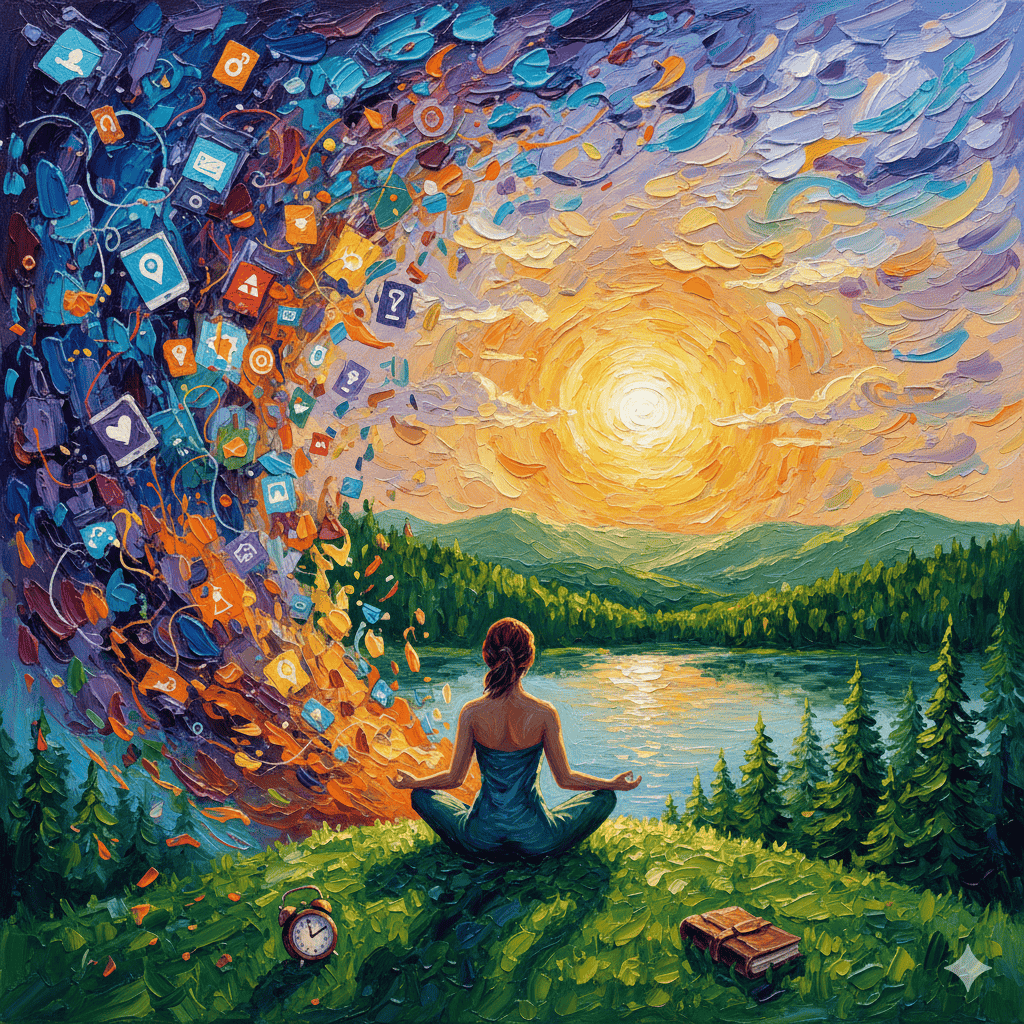
The Great Cognitive Fragmentation
In the mid-2020s, the “infinite scroll” transitioned from a social novelty to a global health crisis. By 2026, the average adult interacts with their smartphone over 2,600 times a day. We are living in a state of continuous partial attention, where the brain is never fully “on” a single task, nor fully “off” to rest.
The benefits of unplugging are no longer just about “taking a break.” They are about reclaiming the biological sovereignty of the human mind.
1. The Biological Blueprint: Cortisol and the Dopamine Loop
The most immediate benefit of unplugging is the stabilization of your endocrine system. Every notification – whether a work email or a social “like” – triggers a micro-release of cortisol (the stress hormone) and dopamine (the reward chemical).
When this cycle repeats hundreds of times an hour, the brain’s “reward threshold” rises. You become incapable of enjoying a quiet sunset or a deep conversation because they don’t provide the rapid-fire dopamine hits of a TikTok feed. This is known as Digital Anhedonia.
The Benefit: By unplugging for just 48 hours, you allow your dopamine receptors to “downregulate.” This restores your ability to feel pleasure from simple, analog experiences – the taste of coffee, the texture of a book, the sound of the wind.
2. Reclaiming the “Deep Work” Muscle
In his 2026 research updates, social psychologist Jonathan Haidt and others have noted that our “attention span” has been physically shortened by digital consumption. We have lost the ability for Deep Work – the capacity to focus without distraction on a cognitively demanding task.
The Benefit: Unplugging is “resistance training” for your focus. When you remove the option of digital escape, your brain is forced to stay with a single thought. Over a week-long detox, users report a 30% increase in problem-solving speed and a return of the “flow state” – that elusive feeling where time disappears because you are so deeply immersed in a physical task.
3. The Sleep-Light Axis: Melatonin and Recovery
The blue light emitted by screens mimics the short-wavelength light of the morning sun. When you check your phone at 11:00 PM, you are effectively telling your pineal gland that it is 8:00 AM. This suppresses melatoninproduction, the hormone essential for deep, restorative sleep.
The Benefit: Following a “Digital Sunset” (turning off all screens two hours before bed) leads to an average increase of one hour of REM sleep per night. REM sleep is where emotional processing and memory consolidation happen. An unplugged night is the difference between waking up “functional” and waking up “inspired.”
4. The Social Paradox: Connection vs. Presence
We are the most “connected” generation in history, yet the loneliest. Digital connection is low-resolution. It lacks the non-verbal cues – pupil dilation, micro-expressions, and pheromones – that the human nervous system requires to feel “safe” and “bonded.”
The Benefit: Unplugging transforms “contacts” back into “connections.” When you meet a friend without a phone on the table, your oxytocin levels (the bonding hormone) are significantly higher. You aren’t just exchanging data; you are sharing an experience.
5. The Nature Dose: Biophilia and Stress Reduction
The “Unplugged” life is almost always an “Outdoors” life. The Biophilia Hypothesis suggests that humans have an innate emotional connection to several organic life forms. When we are tethered to tech, we are alienated from our natural habitat.
The Benefit: A 2025 study from the University of Exeter confirmed the “120-minute Rule”: 120 minutes of nature immersion per week is the minimum effective dose for a significant jump in life satisfaction. Unplugging provides the time to hit this quota.
6. Case Study: The Stanway Experiment (Verified)
As we discussed in our earlier research, the University of York’s study of Year 8 students who unplugged for 21 days showed a 20% drop in anxiety markers. This isn’t just a “feeling”- it is a measurable physiological shift. When the “spell” is broken, the nervous system moves from Sympathetic (fight or flight) to Parasympathetic (rest and digest).
7. The Analog Protocol: How to Start
To gain these benefits, you don’t need to move to a cave. You need Analog Anchors.
- The 8-to-8 Rule: No screens before 8:00 AM or after 8:00 PM.
- Physical Replacements: Use a mechanical watch to check the time, a paper map for navigation, and a physical book for entertainment.
- The Weekly Sabbath: 24 hours of total digital abstinence every weekend.
Conclusion: Reclaiming the Human Experience
Unplugging is the ultimate act of rebellion in 2026. It is a refusal to let your attention be harvested for profit. The benefits – mental clarity, deeper relationships, biological health, and creative “flow” – are the true markers of the “New Rich” lifestyle.
As we celebrate the Lunar Reset and look toward the future, remember: the most important notifications aren’t on your screen. They are in your gut, your heart, and the world right in front of you.
Safe External References & Further Reading
- Scientific Basis: National Institutes of Health – Impact of Screen Time on Mental Health
- Support: Internet and Technology Addicts Anonymous (ITAA)
- UK Nature Research: The National Trust – Nature and Wellbeing Report
- The “Flow” Science: Psychology Today – The Power of Flow States
Leave a Reply