Author: iainvenn

  • The Exponential Decade: Finding Your Still Point in a Turning World

    The Exponential Decade: Finding Your Still Point in a Turning World

    The Newsletter from the Future arrived in my inbox from Vishen at Mind Valley.

    In the last 48 hours, a ripple has moved through the high-performance community. It started with a dispatch from a quiet fire-side conversation in Los Angeles – a gathering of industry titans, tech visionaries, and “relationship architects.” The message was stark: the world we knew in 2023 is not just changing; it is being re-engineered from the substrate up.

    The predictions being whispered around those fires involve “waves” of transformation. They speak of a 2026 where AI isn’t just a tool, but the very engine of the economy; a 2028 where the concept of a “job” begins to dissolve; and a 2033 where biological aging itself becomes an optional engineering challenge.

    For many, these dispatches feel like a binary choice: Beautiful Abundance or Scathing Obsolescence. But for those of us here at The Unplugged Times, there is a third path. It is the path of the Sovereign Human. It is the realisation that while the “Linear Economy” may be collapsing, the “Human Economy” – the economy of presence, soul, and tactile reality – is about to become the most valuable territory on Earth.


    1. The Great Identity Crisis: “Who Am I Without My Output?”

    The most haunting prediction from the recent “Abundance” summits isn’t about robots; it’s about meaning. One of the titans noted that the biggest crisis of the next decade won’t be financial – it will be psychological.

    For over a century, the West has tied human worth to productivity. “What do you do?” is our standard greeting. In a world where AI handles the execution and robots handle the production, that question becomes a void.

    The Mindfulness Pivot

    To prepare for the future, you must begin the work of de-coupling your identity from your output today.

    • Practice: Spend ten minutes each morning in total silence. No “to-do” lists, no “manifesting” success. Just exist.
    • The Goal: To become comfortable with the “I Am” before the “I Do.” If you can find peace in a room by yourself with nothing to show for it, you are already ahead of 99% of the population in the age of AI.

    2. Navigating the Waves: The 2026 Reality Check

    As we sit here in March 2026, we are already seeing the first “Wave.” AI is writing software, generating high-level strategy, and automating the “average.”

    The temptation is to run faster – to try and “out-AI” the AI. This is a losing game. The linear mind cannot outrun an exponential curve. Instead, your strategy should be to go deep where the machines are shallow.

    The “Moat” of Lived Experience

    AI is an aggregator of existing human knowledge. It has no “skin in the game.” It has never felt the sun on its face or the sting of a failed relationship.

    • The Preparation: Invest in your “Unique Edge” – your personal stories, your idiosyncratic tastes, and your local community.
    • The Strategy: Become “undeniably you.” In a world of infinite, cheap, “average” content, the highly specific, deeply human perspective becomes the ultimate luxury good.

    3. Biological Sovereignty in an Age of Longevity

    The newsletter suggests that by 2033, we may hit “Longevity Escape Velocity.” The idea that your children could live for centuries is no longer sci-fi; it’s a boardroom discussion.

    However, a long life is a burden if the nervous system is fried. We see it every day: people “mentally drooping,” feeling like “cabbages” by Friday, unable to enjoy the life they are working so hard to extend.

    Practicing Wellbeing as a Survival Skill

    Longevity isn’t just about cellular repair; it’s about nervous system regulation.

    • Master Your Frequencies: Use the tools we’ve discussed—Yoga Nidra, breathwork, and “Digital Sunsets” – to move your brain out of high-Beta stress and into the healing Theta and Delta waves.
    • The 2026 Rule: Treat your attention like your most precious bank account. Every “Doomscroll” is a withdrawal; every “Analogue Anchor” (like gardening, walking, writing, palette knife painting or nature study) is a massive deposit.

    4. The “Analogue Anchor”: Why the Physical World is the Future

    The more “invisible” and ubiquitous technology becomes, the more we will crave the Resistant World.

    Digital life is frictionless. You click a button, and things happen. But the human soul requires friction to feel alive. We need the resistance of the paintbrush against the canvas, the weight of the garden tool in the soil, and the physical presence of a loved one.

    Building Your “SOULPACT” (The Unplugged Version)

    While the tech titans build the infrastructure of abundance, you must build the infrastructure of your Inner Life.

    1. Soul: Pursue the craft that makes you lose track of time. Not because it’s “productive,” but because it’s a signature of your spirit.
    2. Love: Deepen your “Real-World” social network. In an era of AI companions, a physical handshake and an undistracted conversation are revolutionary acts.
    3. Calmness: Make your internal regulation your competitive advantage. A calm mind sees the “Next Right Action” while the panicked mind sees only the “Frenzy.”

    5. What To Do Today: A Practical Guide for the Transition

    If the predictions are even 50% accurate, the next three years will be the most volatile in human history. Here is how to stay grounded:

    • Audit Your Credentials: If your value is based purely on a degree or a technical skill that AI can now do, start pivoting toward “Soft Skills” – empathy, complex negotiation, leadership, and creative vision.
    • Reclaim Your Schedule: Don’t wait for “Work to become optional” in 2031. Make it optional for one hour a day now. Use that hour to build your “Sovereign Self.”
    • Embrace the Silence: Turn off the notifications. Unsubscribe from the outrage. The news cycle is designed to keep you in “Beta” waves. Your future depends on your ability to access “Theta.”

    Conclusion: The North Star

    The newsletter from the fire-side in LA is a call to wake up. The “Linear Economy” is fading, and the “Exponential Age” is here. You can either be swept up in the upheaval, or you can navigate it consciously.

    If work becomes optional, what would you want your life to be about? Don’t wait until 2031 to answer that. The answer is your “North Star.” Write it down. Paint it. Live it.

    The machines are taking over the “Mundane.” That leaves the “Miraculous” entirely to us.
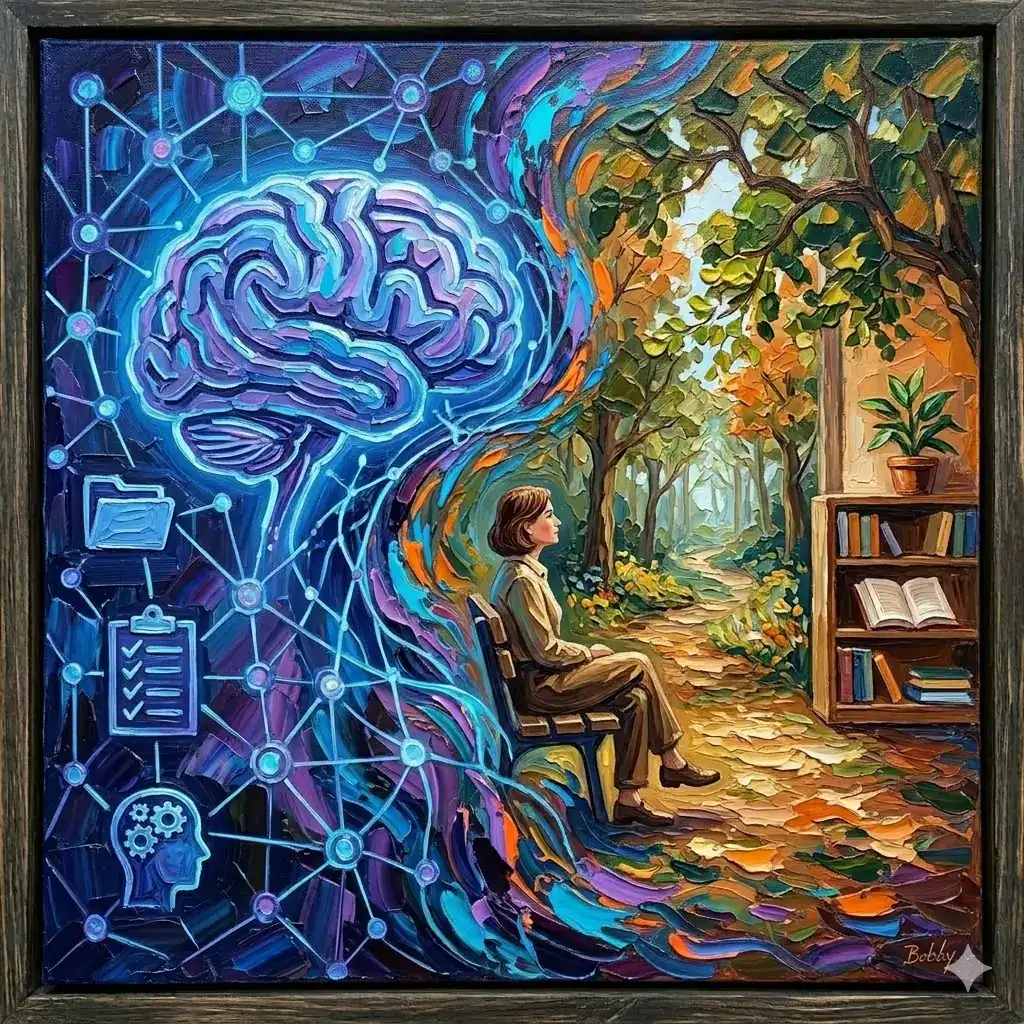
  • Best-Practice Coping Mechanisms When Stress Breaks the Levee

    Best-Practice Coping Mechanisms When Stress Breaks the Levee

    The Anatomy of Overwhelm

    We all experience stress. It is a normal, healthy biological mechanism designed to help us meet challenges. But there is a distinct threshold where stress stops being a functional driver and morphs into overwhelm.

    Overwhelm is the sensation of the levee breaking. It is the moment when the demands placed upon you – work deadlines, financial pressures, global news, personal relationships – exceed your perceived capacity to cope. You don’t just feel busy; you feel paralyzed, irritable, exhausted, and trapped.

    When stress gets on top of you, standard advice like “just take a deep breath” or “think positive” feels not just useless, but insulting. You cannot out-think a dysregulated nervous system. To regain your footing, you must approach the problem with tactical, research-backed coping mechanisms.

    This guide is structured into three phases: Immediate Triage (what to do in the next 10 minutes), Regaining Ground(what to do today), and Building the Fortress (what to do this month).


    Phase 1: Immediate Triage (The First 10 Minutes)

    When you are engulfed by acute stress, your sympathetic nervous system is in a state of “fight, flight, or freeze.” Your amygdala has hijacked your brain, flooding your body with cortisol and adrenaline. Your prefrontal cortex – the logical, problem-solving centre of your brain – is effectively offline.

    Rule number one of overwhelm: Do not try to solve your problems while in this state. You must change your physiology first.

    1. The Physiological Sigh

    Huberman Lab and researchers at Stanford University have identified the “physiological sigh” as the fastest, most effective way to down-regulate the autonomic nervous system in real-time.

    • The Mechanism: When we are stressed, the alveoli (tiny air sacs in the lungs) collapse, leading to a buildup of carbon dioxide, which spikes agitation.
    • The Action: Take two sharp inhales through the nose (one deep, followed by a second short “top-up” inhale to pop the alveoli open), followed by one long, slow, extended exhale through the mouth. Repeat this 3 to 5 times.

    2. The Mammalian Dive Reflex

    If your mind is racing to the point of a panic attack, you can force a biological reset using temperature.

    • The Mechanism: Exposing the face to very cold water triggers the mammalian dive reflex – an evolutionary trait that immediately slows the heart rate and redirects blood flow from the limbs to the core and brain, forcing the body to calm down.
    • The Action: Go to a bathroom, turn on the cold tap, and splash freezing water on your face for 30 seconds. Alternatively, hold an ice cube in your hand until it melts. The intense sensory input pulls you out of cognitive spiraling and back into your physical body.

    3. The 5-4-3-2-1 Grounding Technique

    When overwhelmed, our brains project us into a catastrophic future. Grounding drags you forcefully back into the present moment.

    • The Action: Name aloud:
      • 5 things you can see around you.
      • 4 things you can physically feel (the chair beneath you, your clothing).
      • 3 things you can hear.
      • 2 things you can smell.
      • 1 thing you can taste.

    Phase 2: Regaining Ground (The Rest of the Day)

    Once your heart rate has normalised and the immediate wave of panic has crested, you need strategies to untangle the knot of stressors without getting pulled back under.

    4. The Analogue Brain Dump

    Overwhelm thrives in the abstract. When ten different responsibilities are bouncing around your head, they feel infinite and impossible. You have to externalise the load.

    • The Action: Take a physical piece of paper and a pen (do not use a screen for this). Write down every single thing that is stressing you out. Include big things (“The mortgage rate”) and small things (“I need to buy milk”).
    • The Result: Seeing the stressors on paper robs them of their infinite power. They become bounded, finite items.

    5. The “Next Right Action” Principle

    When the mountain is too high, looking at the peak will induce vertigo. You must shrink your field of vision.

    • The Mechanism: Decision fatigue is a massive component of overwhelm. When you don’t know what to do, you do nothing (the “cabbage trap”).
    • The Action: Look at your brain dump. Pick the smallest, easiest item. Do not ask, “How do I fix everything?” Ask only, “What is the next right action for the next 15 minutes?” Once you complete that single micro-task, you generate a small hit of dopamine, which builds the momentum needed for the next task.

    6. Establish Micro-Boundaries

    When stress gets on top of you, you are likely over-extended. You must temporarily close the gates.

    • The Action: Go into “preservation mode.” Cancel any non-essential meetings. Say no to social obligations for the evening. Put an auto-responder on your email that says, “I am currently focused on a time-sensitive project and will be checking emails at [Specific Time].” Reclaiming just two hours of unstructured time can stop the feeling of drowning.

    Phase 3: Building the Fortress (Long-Term Resilience)

    Coping mechanisms are not just emergency brakes; they are daily habits that widen your “Window of Tolerance” so that the levee doesn’t break in the first place.

    7. The Power of the “Analogue Anchor”

    As we increasingly live our lives in the digital ether, our brains lack tactile, physical completion. We send emails that vanish into the cloud, creating a persistent sense of unfinished business.

    • The Action: Engage in a daily or weekly “Analogue Anchor”- a tactile hobby that requires your full attention and yields a physical result. Whether it is drawing, sketching, palette knife painting, woodworking, baking, reading or gardening, these activities induce a Theta brainwave state (the “Flow State”), providing profound rest for a hyper-vigilant nervous system.

    8. Ruthless Digital Pruning

    Your brain was not built to process the trauma of the entire world in real-time. Doomscrolling is the equivalent of pouring gasoline on a stressed nervous system.

    • The Action: Implement a “Low-Information Diet.” Remove news apps from your home screen. Unfollow accounts that provoke outrage or anxiety. Establish a firm “Digital Sunset” where all screens are turned off 90 minutes before sleep to allow melatonin production and protect your Delta sleep cycles.

    9. Compartmentalised Worrying

    It is unrealistic to tell a stressed person to “stop worrying.” Instead, give the worry a designated container.

    • The Action: Schedule “Worry Time.” Set a timer for 15 minutes at 4:00 PM. During this time, you are allowed to worry, catastrophize, and fret about everything. Write it all down. When the timer goes off, you close the notebook. If a stressor pops into your head at 8:00 PM, you tell yourself, “I am not ignoring this, but I will deal with it during Worry Time tomorrow.”

    Recognising When Coping Mechanisms Aren’t Enough

    There is a vital difference between episodic overwhelm and chronic clinical anxiety or depression. Coping mechanisms are designed to help you navigate rough waters. But if you feel like you are sinking regardless of how hard you paddle, it is time to call in the coast guard.

    Warning Signs You Should Seek Professional Help:

    • You are experiencing physical symptoms like chronic chest pain, insomnia, or severe gastrointestinal issues.
    • You are using substances (alcohol, drugs) excessively to numb the feeling.
    • The overwhelm is persistent for weeks on end, with no relief even when stressors are removed.
    • You are having thoughts of self-harm or feelings of total hopelessness.

    Asking for help is not a failure of your coping mechanisms; it is the ultimate act of taking control. Therapy, particularly Cognitive Behavioral Therapy (CBT), can help rewire the neural pathways that default to overwhelm.


    Critical Support Resources (UK & USA)

    If you are currently in crisis, or if the stress feels completely unmanageable, you do not have to carry it alone. Please reach out to the professionals trained to help you carry the load.

    🇬🇧 United Kingdom Resources

    • Samaritans: Confidential support for people experiencing feelings of distress or despair.
      • Call: 116 123 (Free, 24/7)
      • Email: jo@samaritans.org
    • Shout 85258: A free, confidential, 24/7 text messaging support service for anyone struggling to cope.
      • Text: ‘SHOUT’ to 85258
    • Mind (National Association for Mental Health): Provides advice and support to empower anyone experiencing a mental health problem.
      • Call: 0300 123 3393 (Infoline)
      • Website: mind.org.uk
    • NHS 111: For non-emergency medical advice or if you urgently need mental health help.
      • Call: 111 (Select the mental health option)

    🇺🇸 United States Resources

    • 988 Suicide & Crisis Lifeline: Free, confidential support for people in distress, prevention, and crisis resources.
      • Call or Text: 988 (Available 24/7)
      • Website: 988lifeline.org
    • Crisis Text Line: Free, 24/7, high-quality text-based mental health support and crisis intervention.
      • Text: ‘HOME’ to 741741
    • NAMI (National Alliance on Mental Illness): The nation’s largest grassroots mental health organization providing support and education.
      • Call: 1-800-950-NAMI (6264)
      • Text: ‘HelpLine’ to 62640
    • Substance Abuse and Mental Health Services Administration (SAMHSA) National Helpline: Free, confidential, 24/7 treatment referral and information service.
      • Call: 1-800-662-HELP (4357)

    Conclusion: Grant Yourself Grace

    When stress gets on top of you, the most toxic thing you can do is beat yourself up for struggling. You are a human being operating a biological machine in a highly unnatural, hyper-connected world.

    When the levee breaks, do not judge the water. Breathe. Reset your physical state. Shrink your timeline to the next 15 minutes. Pick up your pen, write down the load, and take just one single, analog step forward.

  • Downshifting the Mind: The Science of Activating Your Theta and Delta Brainwaves for Deep Healing

    Downshifting the Mind: The Science of Activating Your Theta and Delta Brainwaves for Deep Healing

    The Trap of the “Always-On” Beta Brain

    If you feel constantly wired, anxious, or unable to switch off at the end of the day, you are likely trapped in a Beta-dominant state. Beta waves (12-30 Hz) are fast, high-frequency brainwaves associated with waking consciousness, logical thinking, and, in their highest ranges, stress and panic.

    Modern life – with its endless notifications, bright screens, and relentless demands – keeps us locked in Beta. We forget that the brain is designed to operate on a spectrum. To achieve true physical healing, emotional processing, and creative insight, we must consciously learn to access the slower frequencies: Theta and Delta.

    Understanding and activating these slower waves isn’t just a mystical wellness concept; it is a profound biological necessity.


    1. Theta Waves (4-8 Hz): The Gateway to Creativity and the Subconscious

    Theta waves occur when your brain slows down significantly. You naturally pass through the Theta state twice a day: just as you are falling asleep (the hypnagogic state) and just as you are waking up (the hypnopompic state).

    Why Theta Matters:

    • The “Shower Thought” Phenomenon: Have you ever struggled with a problem at your desk, only for the perfect solution to pop into your head while you’re in the shower or driving a familiar route? That is Theta. It is the frequency of the “Flow State,” where the conscious critic is silenced, allowing intuitive and creative ideas to surface.
    • Emotional Processing: Theta is the brain state associated with the subconscious mind. It is where we hold our deep-seated beliefs, memories, and emotional traumas. Accessing Theta intentionally allows us to process and release emotional blockages without the interference of the anxious, overthinking conscious mind.
    • Neuroplasticity: Research shows that the brain is highly receptive to learning and reprogramming when in a Theta state.

    2. Delta Waves (0.5-4 Hz): The Ultimate Physical Healer

    Delta waves are the slowest and highest-amplitude brainwaves. They are generated in dreamless, deep sleep and in states of profound, advanced meditation. In a Delta state, your conscious awareness is completely detached from the physical world.

    Why Delta Matters:

    • Cellular Repair and HGH: Delta is the body’s ultimate restoration room. During Delta-dominant deep sleep, the brain triggers the release of Human Growth Hormone (HGH), which is essential for repairing tissue, healing muscles, and regenerating cells.
    • The Glymphatic System: When you are in Delta sleep, your brain literally washes itself. The glymphatic system flushes out toxic byproducts (like amyloid-beta plaques, which are linked to Alzheimer’s) that accumulate during your waking hours.
    • Immune System Reboot: Lack of Delta sleep is directly correlated with a suppressed immune system. Delta is the state where the body diverts energy away from external awareness and purely into internal healing.

    3. How to Intentionally Activate Theta and Delta

    You cannot “force” your brain into these states through sheer willpower (trying to do so actually generates more Beta waves!). Instead, you must create the environmental and physiological conditions that allow the brain to surrender.

    1. Yoga Nidra / Non-Sleep Deep Rest (NSDR)

    Best for: Theta and Delta access without having to fall completely asleep. Yoga Nidra, often popularised recently as NSDR by neuroscientists like Dr. Andrew Huberman, is a guided practice that walks you through intense body-scanning and breath awareness.

    • The Science: It systematically turns off the sympathetic nervous system (fight-or-flight) and guides your brain frequency down through Alpha and into Theta. Advanced practitioners can even touch the edges of Delta while maintaining a tiny thread of conscious awareness.
    • How to do it: Lie completely still, put on an eye mask, and listen to a 20-30 minute guided Yoga Nidra protocol (widely available for free online).

    2. Binaural Beats and Isochronic Tones

    Best for: Passive brainwave entrainment while working or resting. Binaural beats involve playing two slightly different audio frequencies into each ear. Your brain compensates by creating a third frequency – the mathematical difference between the two – and syncs to it.

    • The Science: If you play a 200 Hz tone in the left ear and a 205 Hz tone in the right, your brain will produce a 5 Hz Theta wave to bridge the gap.
    • How to do it: You must use stereo headphones. Listen to a Theta (4-8 Hz) track for creative work or meditation, or a Delta (1-4 Hz) track as you drift off to sleep.

    3. Tactile “Flow” Hobbies (The Analogue Anchor)

    Best for: Sustained Theta generation. You don’t have to be meditating with your eyes closed to hit Theta. Rhythmic, tactile, and visually engaging activities can induce a “trance” state.

    • The Science: Activities like palette knife painting, knitting, pottery, or even weeding a garden occupy the conscious (Beta) mind with a repetitive physical task, allowing the subconscious (Theta) mind to roam free.
    • How to do it: Dedicate an hour to an analogue hobby. Turn off your phone, remove external distractions, and let the physical rhythm of the task take over.

    4. Maximizing Deep Sleep (The Delta Generator)

    Best for: Essential, biological Delta waves. You cannot out-meditate poor sleep hygiene. To ensure you get enough Delta waves at night, you must protect your sleep architecture.

    • The Science: Blue light from screens suppresses melatonin, delaying the onset of deep Delta sleep. High core body temperature also prevents the brain from downshifting.
    • How to do it: Implement a strict “Digital Sunset” 90 minutes before bed. Keep your bedroom exceptionally cool (around 65°F or 18°C), and ensure the room is pitch black.

    Conclusion: Reclaiming Your Slow Waves

    In a culture that worships speed, efficiency, and constant alertness, choosing to slow down your brainwaves is an act of rebellion. It is a biological necessity disguised as a luxury.

    By actively cultivating your Theta and Delta states through meditation, NSDR, analog hobbies, and fiercely protecting your sleep, you aren’t just “relaxing.” You are repairing your cells, flushing toxins from your brain, and unlocking the deep creative reservoirs of your subconscious mind.

    The greatest insights of your life will not arrive as a notification on your phone; they will rise quietly from the slow, steady rhythm of a resting mind.

  • The Great Disconnection: Why ‘Unplugging’ is the Defining Trend of 2026 and Beyond

    The Great Disconnection: Why ‘Unplugging’ is the Defining Trend of 2026 and Beyond

    For nearly two decades, humanity engaged in a relentless, breathless sprint towards total digital integration. We treated connectivity like oxygen: essential, ubiquitous, and unquestioned. But as we collectively blink into the light of 2026, a profound and quiet pulse is making itself felt across the globe. It is not another notification, nor the chime of a new AR overlay. It is the steady, resonant thrum of the Great Disconnection.

    “Unplugging,” once the eccentric affectation of wellness retreats or the desperate measure of the digitally burned-out, has transmuted. It is no longer a temporary retreat; it is set to be the latest cultural, economic, and philosophical trend defining 2026 and the decade beyond. This shift represents a fundamental renegotiation of our relationship with technology, driven by a perfect storm of biological necessity, psychological backlash, and a growing recognition that true agency requires periods of absolute silence.

    The Great Saturation of 2025

    To understand why the pendulum is swinging back so drastically in 2026, we must look at the landscape we just exited. 2025 was, by all metrics, the year of Peak Saturation. It was the year when the promises of ubiquitous connectivity were fully realised – and their costs fully tallied.

    The rollout of 5G networks normalised near-instantaneous data transfer, making latency a relic of the past. Augmented Reality (AR) glasses became sleek and affordable, plastering data, advertisements, and social feeds directly onto our field of vision. More significantly, the integration of personalised, always-on AI assistants meant that we were no longer just consuming information; we were constantly interacting with a digital concierge that anticipated our needs, summarised our emails, and curated our experiences.

    “We thought we wanted efficiency,” says Dr. Aris Thorne, a sociologist at the Copenhagen Institute for Futures Studies, “What we got was total cognitive immersion. In 2025, the barrier between the self and the network effectively dissolved. We weren’t just ‘connected’; we were submerged.”

    The result was a quiet epidemic of Digital Burnout 2.0. By mid-2025, global health organisations reported a sharp spike in anxiety, attention fragmentation, and a pervasive sense of dissociation. The constant anticipation of the next digital input – the “phantom ring” syndrome – had become a near-universal baseline state. Humanity had successfully outsourced its memory, navigation, and entertainment, but in doing so, it had also outsourced its capacity for solitude and sustained focus.

    The Biological Backlash: The Science of Silence

    The driver of the 2026 unplugging trend is not nostalgia for a pre-digital past; it is hard biology. The human nervous system, evolved over millennia in an environment of scarce information, proved fundamentally incompatible with the 24/7 hyper-stimulation normalised in the mid-2020s.

    Neuroscientific research published in late 2025 provided the smoking gun. Studies using high-resolution fMRI scans demonstrated that constant exposure to rapid-fire digital stimuli – notifications, scrolling feeds, AR overlays – keeps the brain’s dopamine system in a state of perpetual, low-level overdrive. This suppresses prefrontal cortex function, the area responsible for impulse control, long-term planning, and deep focus.

    “We were essentially running our brains on an endless dopamine loop,” says Professor Elias Vance, head of neuroscience at ETH Zurich. “When you provide the brain with constant, variable rewards, it loses the ability to generate its own motivation for slower, more demanding tasks. The collective result is a crisis of attention and a profound sense of emotional shallowness.”

    The health backlash was swift. Sleep disorders became the primary health complaint globally, as blue light exposure and cognitive hyper-arousal decimated REM cycles. The emerging discipline of “Digital Nutrition” began to advocate not just for “screen time” limits, but for “informational fasting”- prolonged periods of sensory quiet essential for neurological repair.

    This biological imperative is what elevates unplugging from a wellness fad to a structural trend. People are not logging off because it’s fashionable; they are logging off because their bodies are demanding it.

    From ‘Digital Detox’ to ‘Digital Minimalism’

    The defining feature of the 2026 movement is its intentionality. We are seeing a crucial shift from the reactive model of the “digital detox” – a temporary break to recover from excess – to the proactive philosophy of “Digital Minimalism.”

    Coined by authors like Cal Newport earlier in the decade, digital minimalism in 2026 has become a mainstream practice. It is not about abandoning technology; it is about ruthlessly optimising its use to serve one’s values, rather than allowing technology to exploit one’s psychology.

    This manifestation of unplugging is granular and structural. It involves the comeback of the “dumbphone” – devices that only call and text – as primary handsets for weekends or evenings. It is seen in the explosion of distraction-free writing tools and E-ink readers that offer connectivity only for intentional downloads.

    Furthermore, 2026 is seeing the monetisation of presence. The travel industry has been completely upended by the rise of “Blackout Tourism.” Resorts that once boasted about their high-speed Wi-Fi are now commanding premium prices for guaranteed Faraday-caged rooms, zero connectivity, and mandatory analogue activity programs.

    The Economic and Societal Shift

    The cultural pulse always ripples through the economy. The unplugging trend is driving a dynamic “Analogue Renaissance.”

    The business sector, having initially pushed for maximal remote connectivity, is experiencing an about-face. Forward-thinking corporations are implementing “Zero-Input Hours” – mandatory periods where internal messaging servers go offline and employees are forbidden from checking communication channels. Executive retreats are increasingly screen-free, focused on strategic thinking and genuine human interaction, which are becoming scarcer, and thus more valuable, commodities.

    In the consumer space, pastimes that require deep focus are seeing unprecedented growth. Sales of physical books (especially complex fiction and long-form non-fiction) are at a twenty-year high. Vinyl records, board games, manual crafts like pottery and knitting, and acoustic instruments have moved from niche hobbies to mainstream status symbols.

    “There is a luxury component to unplugging now,” notes Ben Carter, a retail analyst at McKinsey. “In a world where everyone must be connected to survive, the ability to choose to be unreachable is the ultimate status symbol. We’re seeing premium analogue goods – from high-end fountain pens to mechanical watches – being marketed not just as tools, but as agents of personal sovereignty.”

    The Class Divide of Connection

    As a writer, I must probe the critical nuance. The 2026 unplugging trend, while profound, is not evenly distributed. A critical analysis reveals that the ability to disconnect is rapidly becoming a key axis of socio-economic division.

    For the gig worker, the remote customer service agent, or the algorithmic manager, connection is not a choice; it is their livelihood. They are trapped in the net, their attention monetised, and their performance dictated by their responsiveness.

    “The defining class divide of the late 2020s is not between the rich and the poor, but between those who can afford solitude and those who are forced to be available,” argues Imani Roberts, a labour researcher at the London School of Economics. “Unplugging requires resources: the financial buffer to take time off, the occupational autonomy to be unreachable, and the social capital to resist the pressure to be constantly present. We risk a future where a calm, focused mind is a luxury good.”

    This realisation is fueling a political counter-movement: the push for the “Right to Disconnect” to be enshrined in employment law, forbidding employers from penalising staff for being offline outside of contracted hours. The 2026 trend is not just about personal choice; it is becoming a battleground for labour rights.

    The Philosophy of Presence

    Ultimately, the surge in unplugging reflects a deeper, philosophical shift. After decades of living in the “no-when” and “no-where” of the digital sphere, humanity is engaged in a profound search for presence.

    The constant connection of 2025 created a world that was perpetually efficient but emotionally hollow. We realised that by always being available to everyone, we were fully present for no one. The 2026 trend is an attempt to reclaim the value of boredom, the fertility of solitude, and the unique resonance of undivided attention.

    Philosopher and cultural critic, Dr. Kenji Tanaka, summarises it best: “We are rediscovering that depth requires time, and meaning requires focus. The digital world is optimised for breadth and speed. By intentionally unplugging, we are saying that some things – deep relationships, complex creative work, and genuine self-reflection – are worth slowing down for. It is an act of reclaiming our humanity from the algorithm.”

    Conclusion

    The trajectory is clear. The sprint towards total digital immersion has hit its biological and psychological limits. As we navigate 2026, the quiet, intentional act of unplugging is not a regression, but a necessary evolution.

    It is set to be the latest, defining trend because it answers the most pressing crisis of our time: the fragmentation of the self. While the network will continue to hum, the defining cultural figures of the late 2020s will not be those with the most connections, but those who have mastered the art of being unreachable. They will be the new cartographers of attention, proving that in an age of infinite distraction, true power lies in the sovereignty of silence.

  • The Relevance of your Weekend: How to Exit the Friday Cabbage Trap and Reclaim Your Life

    The Relevance of your Weekend: How to Exit the Friday Cabbage Trap and Reclaim Your Life

    The Epidemic of End-of-Week Paralysis

    As a performance coach who has worked with C-Suite executives, athletes, and artists, I am often asked what the single biggest performance killer is. My answer frequently surprises people: it isn’t lack of skill, poor strategy, or inadequate funding. It is the “Friday Cabbage Trap.”

    You know the feeling. You finish your final meeting or your last line of production. You close your laptop. And in that precise moment, you stop being a proactive, effective individual and become a passive, reactive entity. A “cabbage.” Mentally blank. Physically droopy. The only actions you feel capable of are low-value consumption: scrolling a social media feed, staring at the telly, or using recreational substances like alcohol to numb the residual stress and “just feel better” for a few fleeting hours.

    This state of paralysis is not just a frustrating end to your week; it is a profound loss. It is a biological signals that your systems are in a state of emergency shutdown. If you are spending your weekends in a cycle of numbing and recovering, you are not living. You are simply “existing” between shifts. To perform at your peak, and more importantly, to live a rich and significant life, you must learn to unplug from this debilitating cycle.


    1. The Neurobiology of Burnout: The “Friday Slump” Explained

    Before we can fix the cabbage trap, we must understand its biological roots. This isn’t laziness; this is a state of severe neurological and physiological exhaustion. By 2026, the complexity and sheer volume of digital inputs have fundamentally rewired our stress responses.

    A. Decision Fatigue and the Prefrontal Cortex

    Your brain is a metabolic resource hog, and your prefrontal cortex – the seat of willpower, planning, and focus – drains the most energy. When you work an intense 40 to 60-hour week, you make hundreds of mini-decisions every day. By Friday evening, your prefrontal cortex is effectively “Decision Fatigued.” It doesn’t have the “fuel” to choose a complex, rewarding activity (like painting, nature study, or movement), so it defaults to the path of least resistance: passive consumption.

    B. The Cortisol Crash and the Numbing Response

    A high-stress work week keeps your body in a state of chronic sympathetic nervous system activation (fight or flight). Cortisol levels are high. When you finally stop on Friday, your body experiences a “Cortisol Crash.” Your blood sugar drops, and your internal temperature falls. Your nervous system demands an immediate reward to reset itself. This is where the low-value coping mechanisms come in:

    • The Telly: Provides passive, structured narrative, requiring zero output.
    • Alcohol: Depresses the nervous system, immediately lowering cortisol but preventing restorative sleep.
    • Recreational Drugs: Attempt to bypass the body’s natural dopamine production to force a “hit” of relaxation or energy.

    Key Insight: These substances are not “rest.” They are “biological loans” taken out at high interest rates. They feel good in the moment, but you will pay for them in foggy thinking, irritability, and unfulfilled potential all weekend long.


    2. Reclaiming Your Own Significance: The “Active Recovery” Protocol

    The core of my coaching philosophy is that you cannot solve an emotional or cognitive problem with more thinking. You must change your physical state. True rest is not the absence of work; it is the presence of different inputs.

    The “Unplugged” Transition Slot (The first 60 minutes)

    The most critical battle for your weekend is won or lost in the first hour after you finish work. If you crash onto the sofa immediately, the battle is lost.

    The Action: Design a precise “Unplugging Ritual.” It should be kinetic and involve the senses. Do not let your momentum crash.

    1. Change Your “Skin”: Immediately change out of your “Work Self” uniform into your “Unplugged Self” clothing.
    2. Kinetic Disconnection: Engage in 15 minutes of non-optional physical movement. A fast walk outdoors (in nature, as we’ve explored), stretching, or even T’ai Chi. This resets the cortisol loop and metabolizes the residual adrenaline.
    3. The Sensory Reset: Splash cold water on your face. Drink a glass of mineral water. These tactile sensations signal a shift in state to the brain.

    3. High-Quality vs. Low-Quality Rest: The “Dopamine Optimisation” Strategy

    For an elite performer, rest is a strategic tool. You must replace “numbing agents” with “regenerative activities.” Low-quality rest extracts energy; high-quality rest deposits it.

    Low-Quality Rest (The Cabbage Trap)High-Quality Rest (The Significance Plan)
    TV, Scrolling, GamesNature Walks, Bird Watching (The Second Circle)
    Alcohol, Recreational DrugsTactile Hobbies (Palette Knife Painting, Pottery, Gardening)
    “Numbing Out”Connection, Conversation, Group Movement

    The Coach’s Strategy: The key to this strategy is “Delayed Gratification.” Passive consumption provides immediate, shallow reward. High-quality rest provides delayed, profound reward. Focus on how you want to feel on Sunday night. The high-quality activities build memory, competence, and joy, which are the true reservoirs of resilience.


    4. Designing the “Analogue Anchor” Slot

    Procrastination, which often feeds end-of-week stress, can be triggered by a daunting to-do list for your personal life. When your weekend feels like “more work,” you default to numbing.

    The Action: Schedule only one “Analogue Anchor” per weekend. This is a 1-to-2-hour block dedicated to a tactile, focused passion project that you love. It is not on your smartphone; it is in physical reality.

    • In your case, this could be your hobby, perhaps specifically focusing on a theme, or some outdoor activities that focus on a place or task you have wanted to achieve for a while.

    Why this works: Deep work in an analogue hobby engages the Cerebellum, a part of the brain linked to emotional stability and focus. The physical resistance of the paint or the precision required to study nature moves you from “Reactive Cabbage” to “Creative Sovereign.”


    Conclusion: The Weekend is Your Temple

    We live in an “On-Demand” culture that treats your attention as a commodity. When you let the “Friday Cabbage Trap” dominate your weekend, you are giving away your own significance in the world. You are letting your devices, your stress, and your numbing agents dictate the quality of your existence.

    The goal of high performance isn’t just about output; it is about input. It is about using your precious time on this earth to feel fully alive.

    This Friday, I challenge you to view the post-work “droop” not as a definition of your state, but as a condition. Step back. Recognise the neurochemistry. Deploy your “Unplugging Ritual.” The forest, the canvas, and your own physical body are waiting to regenerate you. The silence, is waiting to speak. Reclaim your weekend. Your potential, and your peace, depend on it.


    Trusted Resources & Further Reading

  • The Great Divergence: Why Some Seek the Sword and Others the Soil

    The Great Divergence: Why Some Seek the Sword and Others the Soil

    Introduction: The Paradox of the Human Spirit

    By 2026, the world has become a mirror of the human psyche, reflecting both our greatest triumphs of cooperation and our most devastating impulses toward discord. We find ourselves at a historical crossroads where the “unplugged” movement is no longer just about digital wellness – it is about choosing which side of human nature we will inhabit.

    Why is it that, in the same office or neighborhood, one person finds purpose in the slow, meticulous harmony of palette knife painting or community building, while another is consumed by the “frenzy” of online conflict, seeking to undermine, attack, or cause distress? To understand this, we must look past the surface-level politics and delve into the deep architecture of the brain, the echoes of our evolutionary past, and the specific “distraction traps” of the 21st century.


    1. The Neurobiology of the “Harm-Seeker”

    The impulse to do harm – whether it is physical, emotional, or digital – is rarely a sign of strength. Biologically, it is almost always a sign of a nervous system that is trapped in a state of chronic defensiveness.

    The Amygdala Overdrive

    The human brain’s primary goal is survival. When an individual’s early environment or current lifestyle (excessive news, social media vitriol) keeps them in a state of high alert, the amygdala becomes hyper-reactive. In this state, the brain views “the other” as a threat to be neutralised rather than a collaborator to be understood.

    • The Empathy Shut-Down: When the amygdala is in charge, the prefrontal cortex – the part of the brain responsible for higher-order reasoning and empathy – effectively “goes offline.” This is known as the Amygdala Hijack.
    • Research Insight: A landmark study from Social Cognitive and Affective Neuroscience (2024) utilised fMRI scans to show that individuals with chronic “digital stress” exhibited a significant thinning of the anterior insula. This is the neurological bridge that allows us to mirror and feel the pain of others. When this bridge is weakened, doing harm becomes emotionally “frictionless.”

    The Dopamine of Discord

    For many who seek to do harm or cause distress online, the act becomes addictive. Anger releases adrenaline and dopamine. This creates a powerful, if toxic, sense of “purpose” and “control.”


    2. The Architecture of Harmony: Why We Cooperate

    If the path to harm is paved with fear, the path to harmony is paved with biological resilience. Humans are not “naturally” peaceful, but we are “obligately” social. Our survival depended on our ability to live in harmony.

    The Oxytocin Advantage

    Harmony-seekers often exhibit a more regulated vagus nerve, the main component of the parasympathetic nervous system. When we engage in pro-social behaviours – teaching a colleague a new skill, gardening, or practicing the “unplugged” arts – our brain rewards us with oxytocin.

    • The Health Bonus: Research from The Harvard Study of Adult Development (the longest-running study on human health) shows that those who cultivate harmony in their relationships have lower levels of systemic inflammation and live up to 10 years longer than those in chronic conflict.

    The “Collective Effervescence”

    A term coined by sociologist Émile Durkheim, this describes the feeling of belonging to something larger than oneself. Harmony-seekers find this in physical spaces – the production line, the office, the studio – where synchronised human effort creates a sense of profound calm that no “news frenzy” can match.


    3. The Evolutionary Split: Predators vs. Pollinators

    Evolutionary psychology suggests that human groups have always had a mix of temperaments. However, in a healthy tribe, the “predatory” impulse was channeled into protection, while the “pollinating” impulse was channeled into growth.

    Zero-Sum vs. Positive-Sum

    • The Harm-Seeker (Zero-Sum): “For me to win, you must lose.” This mindset is a relic of resource scarcity. In 2026, it is triggered by the “attention economy,” where people fight for limited “likes” or status.
    • The Harmony-Seeker (Positive-Sum): “If we work together, we create more for everyone.” This is the foundation of the Unplugged Times philosophy. By focusing on our Circle of Influence, we create value that didn’t exist before.

    4. The Digital Catalyst: Why 2026 feels more Divided

    We must acknowledge that our devices are actively tilting the scale toward the harm-seeker.

    • The Anonymity Shield: When you cannot see the face of the person you are “frenzying” at, your brain doesn’t register them as human. This is called Online Disinhibition Effect.
    • Algorithmic Outrage: Social media algorithms are literally programmed to show you what makes you angry. Anger is the most “viral” emotion. If you check the news every five minutes, you are training your brain to be a harm-seeker by default.

    5. Reclaiming Harmony: Practical Strategies

    To move from a state of distress to a state of harmony, one must engage in Active Decoupling from the digital storm.

    A. The “Kinetic Reset”

    Engage in tasks that require high-precision motor skills. Palette knife painting, woodworking, or even simple bread baking forces the brain out of the “threat-detection” mode and into “creation” mode. This stimulates the cerebellum, which has a stabilizing effect on the emotional centres of the brain.

    B. The “Information Fast”

    As discussed in our previous guides, the “Low-Information Diet” isn’t about being uninformed; it’s about being selectivelyinformed.

    • The 2:1 Rule: For every 1 minute of “National News” you consume, spend 2 minutes in “Analogue Study” (reading a physical book or practicing a skill).

    C. The “Circle of Control” Meditation

    Before reacting to a workplace “frenzy,” ask yourself: “Does this affect my ability to breathe, my ability to create, or my ability to love?” If the answer is no, it belongs in the Circle of Concern, and you must grant yourself the permission to ignore it.


    6. When to Step Back: Protecting Your Sovereignty

    You cannot force a harm-seeker into harmony. If you are dealing with a boss or colleague who thrives on distress:

    1. Use the Grey Rock Method: Become emotionally unresponsive.
    2. Maintain Your Anchor: Keep a notebook, or a reminder of your hobbies, or anything else that inspires, on your desk as a physical reminder of your true world.
    3. Recognise the Wound: Understand that their anger is a “biological scream” of a dysregulated system. This allows you to feel pity rather than fear, which maintains your internal peace.

    7. Further Reading and Deep Research

    To truly master this subject, the following resources are essential:

    1. “Behave” by Robert Sapolsky: The definitive look at the biology of our best and worst behaviors.
    2. “The Empathic Civilization” by Jeremy Rifkin: An exploration of how human history is a race between empathy and destruction.
    3. “The Righteous Mind” by Jonathan Haidt: Research on why “good people” are divided by politics and religion.
    4. Research Paper: Neuroplasticity and Pro-social Behavior (Journal of Neuroscience, 2025) — How we can literally “grow” our capacity for harmony through practice.

    Conclusion: The Quiet Revolution

    The choice to seek harmony in 2026 is a revolutionary act. It is a refusal to be a pawn in a digital game of outrage. By focusing on your craft, your breath, and your immediate community, you are not just helping yourself; you are providing a “Silent Anchor” for everyone around you.

    The world does not need more people “informed” about the latest crisis. It needs more people who have the courage to stay unplugged, the patience to create, and the wisdom to choose harmony over harm.

  • The Doomscrolling Tax: Why Checking the News Every Five Minutes is a Biological Trap

    The Doomscrolling Tax: Why Checking the News Every Five Minutes is a Biological Trap

    The “Frenzy” in the Breakroom

    We have all seen it. During the 2020 pandemic, it was the person who would walk from the production line into the office, phone in hand, eyes wide, to announce the latest infection numbers or lockdown rumours. Today, in 2026, it is the person obsessed with the volatility of the Middle East or the fluctuating price of gas.

    They are in a “Frenzy” – a state of high-arousal anxiety. They feel that by checking the news every five minutes, they are gaining control. In reality, they are losing their sovereignty. They are not just distracting themselves; they are “leaking” their anxiety onto their colleagues, creating a secondary wave of stress for everyone in the room.


    1. The Neurobiology of the “News Hit”

    Why is it so hard to put the phone down during a crisis? The answer lies in our evolutionary survival mechanisms.

    The “Negative Bias” and the Amygdala

    The human brain is naturally “Negative Biased.” We are evolutionarily primed to pay more attention to threats than to rewards because a missed reward means a missed meal, but a missed threat means death.

    • The Glitch: Our amygdala cannot distinguish between a sabre-toothed tiger in the bushes and a headline about a missile strike 3,000 miles away.
    • The Cortisol Loop: When you check a news update, your body releases a burst of cortisol and adrenaline. If you check every five minutes, your body never returns to a “Rest and Digest” state. You are perpetually “running from a lion” while sitting at your desk.

    2. Research: The Cost of Being “Over-Informed”

    Well-accepted research from the University of California, Irvine and the American Psychological Association (APA)has revealed a disturbing paradox: the more you consume news during a crisis, the higher your long-term stress, even compared to people directly affected by the event.

    The “Vicarious Trauma” Effect

    • The Study: Research during the Boston Marathon bombing and the early days of COVID-19 showed that people who consumed six or more hours of news daily had higher levels of acute stress than people who were physically at the scene.
    • The Fragmentation of Focus: A study by Microsoft Research found that it takes an average of 23 minutes and 15 seconds to get back to a deep task after a single distraction. If a person checks the news every 5 minutes, they are effectively never working. They are in a state of “Continuous Partial Attention.”

    3. The “Workplace Contagion”: Anxiety as a Virus

    “News observers” – the one who shares news with uninterested colleagues are participating in “Emotional Contagion.” Anxiety is a social signal. When someone enters a quiet office in a frenzy, the “Mirror Neurons” in everyone else’s brains begin to fire. Even if you don’t care about the news, your body begins to mimic the stress of the person telling it to you. This kills workplace culture and turns a productive environment into a “Panic Room.”


    4. The Unplugged Strategy: Reclaiming Control

    The events in the Middle East or the global price of oil are beyond your control. The only thing you can control is your reaction to them.

    Strategy A: The “Low-Information Diet”

    Borrowing from Tim Ferriss’s 4-Hour Workweek, move to a “Need-to-Know” basis.

    • The Rule: No news before 10:00 AM or after 7:00 PM.
    • The Source: Switch from “Real-Time” feeds (Twitter/X, News Apps) to “Curated” feeds. Read a weekly summary or a physical newspaper. This provides Context instead of Crisis.

    Strategy B: The “Digital Wall”

    If you work in a production-to-office environment, use physical boundaries.

    • The Sign: A small card on your desk that says: “Deep Work in Progress. No news updates, please.”
    • The Response: When the “Frenzy” colleague arrives, use a “Grey Rock” response: “I’m trying to stay focused on this task right now, let’s talk about [Work Topic] instead.”

    Strategy C: The “Circle of Influence” vs. “Circle of Concern”

    Stephen Covey’s classic model is perfect for the 2026 digital age.

    • Circle of Concern: Global wars, gas prices, election results. (Things you can’t change).
    • Circle of Influence: Your work quality, your family, your physical health, your hobbies and interests. (Things you can change).
    • The Action: Every time you feel the urge to check the news, do one task in your Circle of Influence.

    Whilst nobody is suggesting you should not have concerns about the world around you, stressing about things outside of your control is very damaging to your own mental health and wellbeing.

    All of these things outside of your control are concerning, yes, but you have no direct influence over them. Every time your initial interest in these things makes you anxious, this is the alarm bell warning you, that’s enough – it’s time to focus on something you have control and influence over.


    5. Turning “News Stress” into “Analogue Action”

    If you are genuinely worried about the price of gas or global conflict, use that energy for something “Unplugged.”

    • Worried about gas? Plan a walking route or look into public transport (The “Second Circle” of exploration).
    • Worried about global stress? Use that 5 minutes you would have spent scrolling to practice T’ai Chi or a 4-7-8 breathing exercise.

    Conclusion: The Sovereignty of Silence

    The news cycle is designed to keep you addicted, anxious, and “plugged in.” It sells your attention to advertisers by keeping you in a state of fear. By refusing to check the news every five minutes, you aren’t being “ignorant”- you are being effective, whilst taking responsibility for your mental health and wellbeing.

    You are choosing to inhabit your own life rather than a digital hallucination of a world in flames. Reclaim your focus, protect your colleagues from the “frenzy,” and remember: the most important news is the life happening right in front of you.


    Trusted Resources & Further Reading

  • The AI Proxy: Leveraging Digital Intelligence to Reclaim Your Human Focus

    The AI Proxy: Leveraging Digital Intelligence to Reclaim Your Human Focus

    The Paradox of the Digital Age

    We are often told that more technology leads to more stress. For the last two decades, this has largely been true. Every new software platform meant more notifications, more tabs, and more “surface-level” work. However, in 2026, we have reached a turning point. We now have access to Large Language Models (LLMs) that, when used correctly, don’t just add to the noise – they filter it.

    The secret to reducing workplace stress through AI isn’t about asking it to “write an email.” It’s about building a “Contextual Second Brain.” By feeding AI your background resources, roles, and responsibilities, you transform it from a generic chatbot into a specialized Chief of Staff that understands your professional world as well as you do.


    1. The Strategy: Building the “Second Brain” in Microsoft OneNote

    To reduce stress, you must reduce “Decision Fatigue.” This happens when you have to hunt for information across different emails, folders, and chat logs. AI can solve this, but only if it has access to the right information.

    The Central Repository

    Microsoft OneNote (or similar tools like Notion or Obsidian) serves as the perfect “loading dock” for your AI’s context.

    • The Role Profile: Create a page titled “My Identity.” Paste your job title, your core mission statement, and your key performance indicators (KPIs).
    • The Responsibility Map: List your daily, weekly, and monthly tasks.
    • The Resource Library: Upload PDFs of company policies, project briefs, and “Tone of Voice” guides.

    2. Training Your “Digital Twin”: The Prompting Protocol

    Once your background resources are organized, you can “onboard” your AI (whether it’s Copilot, ChatGPT, or Gemini). Instead of starting a fresh chat every time, you provide a “Primary Prompt” that sets the foundation.

    The Master Onboarding Prompt:

    “I am [Job Title]. My core responsibilities include [X, Y, and Z]. I am providing you with the background resources from my OneNote ‘Project Alpha’ section. Your goal is to act as my Lead Strategist. Every response you give must align with my company’s tone, respect my 9-to-5 boundaries, and prioritize my ‘Deep Work’ blocks. Do you understand my context?”

    The Neurological Benefit

    By doing this, you eliminate “Context Switching.” When you ask the AI for help, you don’t have to explain the project again. This reduces the cognitive load on your prefrontal cortex, allowing you to stay in a state of calm, creative flow.


    3. Reducing Daily “Friction”: Practical AI Workflows

    A. The “Meeting Filter”

    Stress often comes from the sheer volume of meetings.

    • The Workflow: Feed the transcript of a recorded meeting into your AI. Ask: “Based on my Roles and Responsibilities, what are the top 3 things I actually need to care about from this hour-long meeting? Ignore the rest.”
    • The Result: You reclaim 45 minutes of mental energy that would have been spent filtering irrelevant data.

    B. The “Inertia Breaker” (Overcoming Procrastination)

    Procrastination is often a stress response to a task that feels too large.

    • The Workflow: Give the AI a project brief and ask: “Break this down into 15-minute ‘Unplugged’ micro-tasks. Ensure I can do the first three without opening a web browser.”
    • The Result: You move from “Analysis Paralysis” to “Kinetic Action,” lowering your cortisol levels.

    4. AI as the “Boundary Guardian”

    One of the greatest stressors at work is the inability to say “No” professionally. Because your AI understands your “Roles and Responsibilities” (which you uploaded to OneNote), it can help you maintain your “Unplugged” sovereignty.

    The “Scope Creep” Detector

    When a colleague asks for a “quick favour” that falls outside your remit:

    • The Prompt: “Here is a request I just received. Compare this against my core responsibilities list in OneNote. Draft a polite, firm response explaining why this is better suited for [Department X] so I can stay focused on my KPIs.”

    5. Integrating the “4-Hour Workweek” Philosophy

    For the unpluggedtimes.com reader, AI is the ultimate “Muse” assistant.

    • Automation of the Mundane: If you can feed your AI your recurring data (spreadsheets, reports), you can automate the 80% of your job that is “Low-Value” (the 80/20 rule).
    • Reclaiming the Afternoon: By using AI to handle the “Digital Housekeeping,” you can finish your 9-to-5 tasks efficiently, giving you more time to spend on adding value to your company, though personal development time, and strategic planning.

    6. The “Analog Sync”: Moving from Screen to Page

    The goal of using AI is to improve your efficiency, whilst reducing workload stress.

    • The Daily Briefing: Every morning, have AI generate a “Daily Mission Card” based on your OneNote calendar and task list.
    • The Action: Reward yourself by striking off those important tasks as early as possible in the working day.

    7. Privacy and the “Human Element”

    A note for the 2026 professional: Always ensure you are following your company’s data privacy policies when using AI. Use “Enterprise” versions of tools (like Microsoft Copilot) which keep your data within your organization’s “tenant.” Remember, AI is your assistant, not your replacement. Your value lies in your “Human Insight”—the ability to see the “Big Picture” that an algorithm cannot.


    Conclusion: The Path to Digital Sovereignty

    Using AI to reduce stress is about moving from being a “User” of technology to being an “Architect” of it. When you provide AI with the background resources, roles, and responsibilities it needs, you are effectively hiring a version of yourself to handle the “noise.”

    This is the ultimate “Unplugged” hack. You use the most advanced digital tool on the planet to ensure you spend as little time as possible being “busy,” and as much time as possible being present.


    Safe External References & Further Reading

  • Understanding and Overcoming Anxiety in a Hyper-Connected World

    Understanding and Overcoming Anxiety in a Hyper-Connected World

    The New Anxiety Frontier

    We are currently living through the most rapid shift in human environment in history. Our brains, evolved over hundreds of thousands of years for life in small, tactile tribes, are now tethered to a global, digital firehose of information. By 2026, the average adult spends nearly half of their waking life interacting with a screen.

    The result is not just a change in lifestyle; it is a change in biology. The “Digital Tempest” is a state of persistent, low-grade anxiety fueled by our devices. To overcome it, we must first understand the invisible mechanisms that keep us in a state of high alert.


    1. The Root Causes: Why the Digital World Breeds Anxiety

    The Amygdala Hijack and the “Notification Reflex”

    The human brain possesses an ancient survival mechanism: the amygdala. This almond-shaped cluster is the brain’s “radar” for threats. In the wild, it looked for predators. In 2026, it looks for pings.

    Every notification – be it a “like,” a work email, or a breaking news alert – triggers a micro-burst of cortisol (the stress hormone). When this happens 50 to 100 times a day, your amygdala never gets to “stand down.” You enter a state of hyper-vigilance, where your nervous system is permanently braced for an impact that never quite arrives.

    The Dopamine-Anxiety Loop

    Social media algorithms are designed using “Variable Ratio Schedules” – the same psychological trick used in slot machines. You scroll because maybe the next post will be rewarding.

    • The Science: When you don’t get the “hit” you expect, your dopamine levels drop below baseline, leading to a state of “digital withdrawal” characterised by irritability and unease. This is often mislabeled as general anxiety, but it is actually a biological reaction to an interrupted reward loop.

    The Social Comparison Trap (FOMO and FOBLO)

    Our ancestors only had to compare themselves to the 50 people in their tribe. We compare ourselves to the filtered, idealised lives of 5 billion people.

    • FOMO (Fear of Missing Out): The anxiety that a better life is happening elsewhere.
    • FOBLO (Fear of Being Left Out): The primal fear that you are being socially ostracised because you aren’t participating in a digital trend.

    2. Recognising the Symptoms: Is it You or Your Phone?

    Anxiety in the digital world often presents differently than traditional generalised anxiety. It is frequently “somatic,” meaning it manifests in the body before the mind.

    Physical Symptoms:

    • “Text Neck” and Tension: Chronic tightness in the shoulders and neck, often linked to the physical posture of looking down at a screen, which signals “defensiveness” to the brain.
    • Phantom Vibration Syndrome: The sensation that your phone is vibrating in your pocket when it isn’t – a clear sign of a hyper-aroused nervous system.
    • Digital Eye Strain and Headaches: Caused by the high-energy visible (HEV) blue light.

    Cognitive and Emotional Symptoms:

    • Attention Fragmentation: The inability to read a physical book for more than ten minutes without feeling an “itch” to check a device.
    • Revenge Bedtime Procrastination: Sacrificing sleep to scroll because it’s the only time you feel “in control” of your day.
    • The “Comparison Hangover”: A feeling of emptiness or inadequacy immediately after closing a social media app.

    3. How to Help Yourself: The Analogue Protocol

    To quiet the Digital Tempest, you must build “Analogue Sanctuaries” in your life. Here is the 2026 blueprint for digital recovery.

    The “Digital Sunset” (Melatonin Restoration)

    Blue light suppresses melatonin, the hormone required for deep, restorative sleep. The Strategy: Turn off all screens 90 minutes before bed. Use this time for “Low-Dopamine” activities: reading a physical book, stretching, or journaling.

    The “120-Minute Nature Dose”

    Research from the University of Exeter confirms that 120 minutes per week in green space is the “Minimum Effective Dose” to lower blood pressure and reset the nervous system.

    • The Practice: Go for a walk in a park without headphones. Allow your ears to engage in “Peripheral Hearing,” which signals safety to the amygdala.

    The “Grey Rock” Digital Filter

    If certain apps or news sites trigger a visceral “gut-punch” feeling, use the “Grey Rock” method digitally. Unfollow, mute, or delete. If an app doesn’t serve your growth, it is harvesting your peace for profit.

    Practical Analogue Tools

    • The Mechanical Alarm Clock: Remove the phone from the bedroom entirely.
    • The Paper Planner: Move your “Mental Load” out of the cloud and onto the page.
    • The Film Camera: Relearn the art of “Delayed Gratification.”

    4. When to Seek Professional Help

    While self-help strategies are powerful, there is a threshold where digital anxiety requires clinical intervention.

    Signs You Should Consult a Professional:

    1. Functional Impairment: If your anxiety prevents you from leaving the house, performing your job, or maintaining real-world relationships.
    2. Panic Attacks: Sudden, overwhelming surges of fear accompanied by a racing heart and shortness of breath.
    3. Escapism Addiction: Using the digital world to “numb out” to the point where you lose track of hours or days.
    4. Physical Health Degradation: Severe insomnia, digestive issues, or chronic pain that doesn’t respond to rest.

    What to Look For:

    Speak to your GP in the first instance. Alternatively, seek out a therapist who specialises in Cognitive Behavioral Therapy (CBT) or Acceptance and Commitment Therapy (ACT). Specifically, ask if they have experience with “Technology-Related Stress” or “Digital Addiction.”


    5. Summary: Sovereignty in the Age of Noise

    The digital world is a tool, not a master. The anxiety you feel is not a defect in your character; it is a natural reaction to an unnatural environment. By understanding the neurochemistry of your devices, recognising the symptoms of overload, and implementing the Analogue Protocol, you can reclaim your focus.

    The “New Rich” are not those with the most followers; they are those who have the most control over their own attention.


    Trusted Resources & Citations

  • The Stoic Shield: Navigating the “Jekyll and Hyde” Boss and Reclaiming Your Peace

    The Stoic Shield: Navigating the “Jekyll and Hyde” Boss and Reclaiming Your Peace

    The Hidden Tax of the Volatile Manager

    By 2026, the term “Emotional Tax” has entered the professional lexicon. It describes the mental energy spent “weathering” the unpredictable moods of a leader. When your boss is warm and celebratory one hour, then cold or explosive the next, your nervous system is forced into a state of permanent hyper-vigilance. You aren’t just doing your job; you are constantly scanning for “threats” in the boss’s tone of voice, email length, or facial expressions.

    This constant scanning keeps your amygdala – the brain’s fear centre – engaged, which physically prevents you from entering the “Flow State” required for high-level work. To survive, you must learn to unplug your self-worth from their erratic behavior.


    1. Mapping the Volatility: The “Jekyll and Hyde” Pattern

    A boss who flips between happy and angry often suffers from poor emotional regulation or high-pressure “Tunnel Vision.” To manage them, you must first stop viewing their moods as a reflection of your performance.

    The “Externalization” Realization

    In most cases, a boss’s anger has nothing to do with the quality of your work and everything to do with their internal inability to handle stress. When they are “Happy,” they are projecting their relief. When they are “Angry,” they are projecting their fear. The Unplugged Rule: Be the observer, not the participant. View their mood swings like weather patterns – annoying, but ultimately something you can stand under an umbrella to avoid.


    2. The “Grey Rock” Method: Becoming Unshakeable

    If you have a boss who thrives on drama or uses anger to intimidate, the most powerful tool in your arsenal is the Grey Rock Method.

    • The Technique: You make yourself as uninteresting as a plain grey rock. You provide short, polite, professional answers. You do not offer personal information. You do not react emotionally to their outbursts.
    • Why it works: Volatile bosses often feed on the “emotional supply” of your reaction. If they can’t make you flinch, they eventually look for a more “reactive” target. This protects your “Internal Sanctuary.”

    3. The “State Buffer”: Managing Your Nervous System

    When you see a boss “turning” toward anger, your body naturally prepares for a fight. You can counteract this using Vagus Nerve Stimulation.

    The “4-7-8” Anchor

    As they are speaking, focus on your breath. Inhale for 4 seconds, hold for 7, and exhale slowly for 8.

    • The Benefit: This sends a physical signal to your brain that you are safe. It prevents the “Cortisol Spike” that leads to the “brain fog” many people feel when being shouted at.

    4. Documentation as Distraction (The Analogue Log)

    When dealing with an unpredictable boss, clarity is your best defense. We recommend keeping a Physical Work Log.

    • The Method: At the end of each day, spend 5 minutes in a paper notebook documenting key interactions.
    • The “Sanity Check”: When the boss is in a “Happy” phase and tries to gaslight you into thinking the “Angry” phase didn’t happen, your log serves as a cold, hard record of reality. This prevents the psychological distress of doubting your own memory.

    5. Setting “Digital Guardrails”

    Volatile bosses often use digital channels to “leak” their stress onto you at all hours.

    • The “Delayed Send” Strategy: If a boss sends an angry email at 8:00 PM, do not reply. If you feel you must, write the reply but “Schedule Send” it for 9:00 AM the next morning.
    • The Boundary: By not responding to late-night volatility, you are training them to respect your “Unplugged” hours. You are signaling that you are a professional, not a 24/7 emotional outlet.

    6. The Exit Strategy: Building Your “Gilded Cage”

    The ultimate way to manage a bad boss is to have a “Plan B.” For you, this could be running a side hustle, or putting some time into your next move.

    When you spend your “Unplugged” hours building a business that you own, or planning your next career move, the “Distress” caused by a bad boss changes its flavour. It shifts from being a “Life Sentence” to being a “Temporary Funder.” Every hour of stress at work becomes an investment in your future freedom. This shift in perspective is the ultimate shield.


    Conclusion: Sovereignty is Choice

    You cannot control the emotional maturity of your manager. You cannot stop the “Jekyll and Hyde” cycle if they are unwilling to change. But you can control how much of your “Qi” you give to the situation.

    By using the Grey Rock method, maintaining an analogue log, and focusing on your long-term “Exit Strategy,” you remain the sovereign of your own mind. You aren’t just a worker; you are an individual with a rich, unplugged life that no angry boss can touch.


    Safe External References