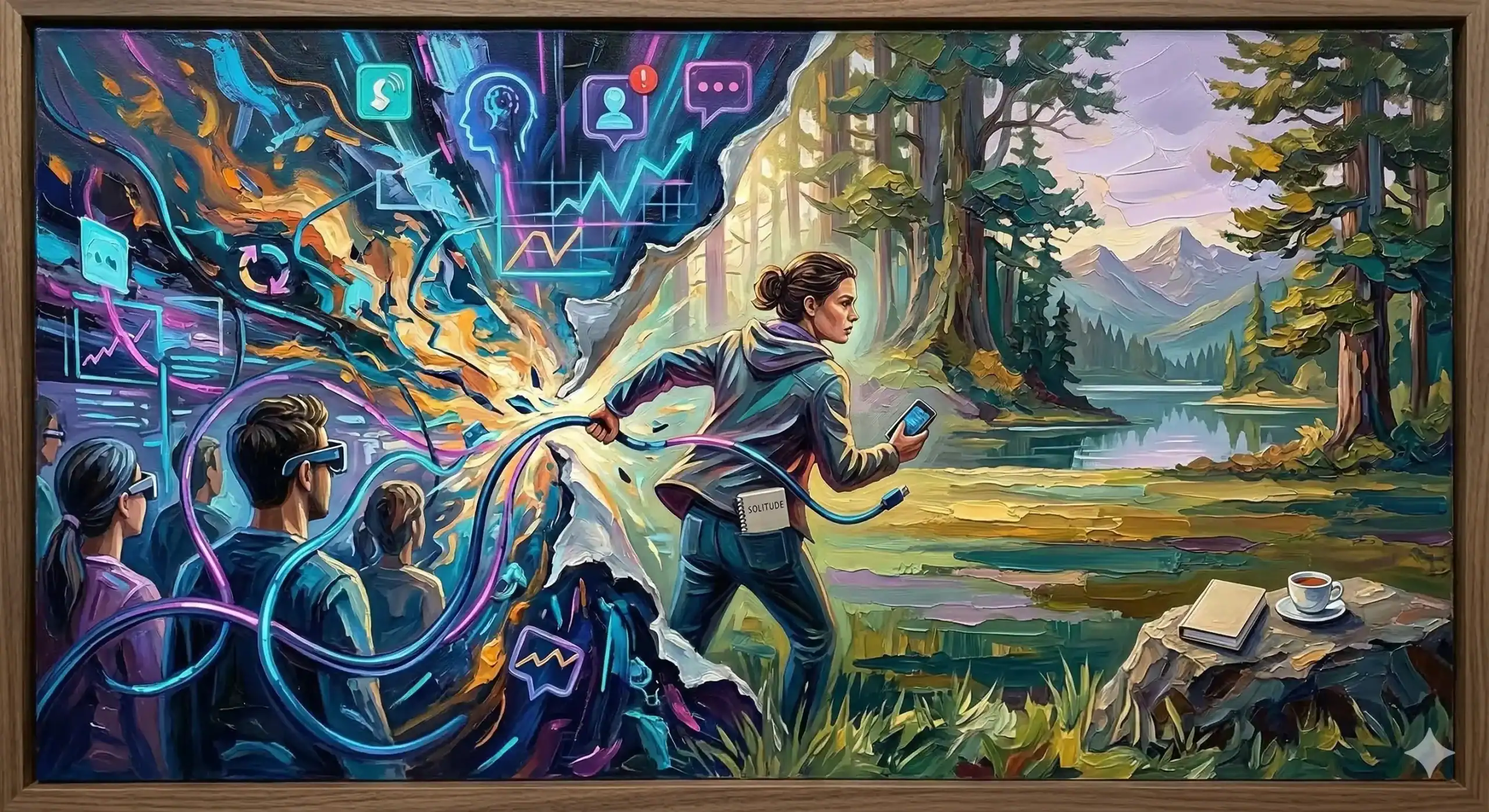
For nearly two decades, humanity engaged in a relentless, breathless sprint towards total digital integration. We treated connectivity like oxygen: essential, ubiquitous, and unquestioned. But as we collectively blink into the light of 2026, a profound and quiet pulse is making itself felt across the globe. It is not another notification, nor the chime of a new AR overlay. It is the steady, resonant thrum of the Great Disconnection.
“Unplugging,” once the eccentric affectation of wellness retreats or the desperate measure of the digitally burned-out, has transmuted. It is no longer a temporary retreat; it is set to be the latest cultural, economic, and philosophical trend defining 2026 and the decade beyond. This shift represents a fundamental renegotiation of our relationship with technology, driven by a perfect storm of biological necessity, psychological backlash, and a growing recognition that true agency requires periods of absolute silence.
The Great Saturation of 2025
To understand why the pendulum is swinging back so drastically in 2026, we must look at the landscape we just exited. 2025 was, by all metrics, the year of Peak Saturation. It was the year when the promises of ubiquitous connectivity were fully realised – and their costs fully tallied.
The rollout of 5G networks normalised near-instantaneous data transfer, making latency a relic of the past. Augmented Reality (AR) glasses became sleek and affordable, plastering data, advertisements, and social feeds directly onto our field of vision. More significantly, the integration of personalised, always-on AI assistants meant that we were no longer just consuming information; we were constantly interacting with a digital concierge that anticipated our needs, summarised our emails, and curated our experiences.
“We thought we wanted efficiency,” says Dr. Aris Thorne, a sociologist at the Copenhagen Institute for Futures Studies, “What we got was total cognitive immersion. In 2025, the barrier between the self and the network effectively dissolved. We weren’t just ‘connected’; we were submerged.”
The result was a quiet epidemic of Digital Burnout 2.0. By mid-2025, global health organisations reported a sharp spike in anxiety, attention fragmentation, and a pervasive sense of dissociation. The constant anticipation of the next digital input – the “phantom ring” syndrome – had become a near-universal baseline state. Humanity had successfully outsourced its memory, navigation, and entertainment, but in doing so, it had also outsourced its capacity for solitude and sustained focus.
The Biological Backlash: The Science of Silence
The driver of the 2026 unplugging trend is not nostalgia for a pre-digital past; it is hard biology. The human nervous system, evolved over millennia in an environment of scarce information, proved fundamentally incompatible with the 24/7 hyper-stimulation normalised in the mid-2020s.
Neuroscientific research published in late 2025 provided the smoking gun. Studies using high-resolution fMRI scans demonstrated that constant exposure to rapid-fire digital stimuli – notifications, scrolling feeds, AR overlays – keeps the brain’s dopamine system in a state of perpetual, low-level overdrive. This suppresses prefrontal cortex function, the area responsible for impulse control, long-term planning, and deep focus.
“We were essentially running our brains on an endless dopamine loop,” says Professor Elias Vance, head of neuroscience at ETH Zurich. “When you provide the brain with constant, variable rewards, it loses the ability to generate its own motivation for slower, more demanding tasks. The collective result is a crisis of attention and a profound sense of emotional shallowness.”
The health backlash was swift. Sleep disorders became the primary health complaint globally, as blue light exposure and cognitive hyper-arousal decimated REM cycles. The emerging discipline of “Digital Nutrition” began to advocate not just for “screen time” limits, but for “informational fasting”- prolonged periods of sensory quiet essential for neurological repair.
This biological imperative is what elevates unplugging from a wellness fad to a structural trend. People are not logging off because it’s fashionable; they are logging off because their bodies are demanding it.
From ‘Digital Detox’ to ‘Digital Minimalism’
The defining feature of the 2026 movement is its intentionality. We are seeing a crucial shift from the reactive model of the “digital detox” – a temporary break to recover from excess – to the proactive philosophy of “Digital Minimalism.”
Coined by authors like Cal Newport earlier in the decade, digital minimalism in 2026 has become a mainstream practice. It is not about abandoning technology; it is about ruthlessly optimising its use to serve one’s values, rather than allowing technology to exploit one’s psychology.
This manifestation of unplugging is granular and structural. It involves the comeback of the “dumbphone” – devices that only call and text – as primary handsets for weekends or evenings. It is seen in the explosion of distraction-free writing tools and E-ink readers that offer connectivity only for intentional downloads.
Furthermore, 2026 is seeing the monetisation of presence. The travel industry has been completely upended by the rise of “Blackout Tourism.” Resorts that once boasted about their high-speed Wi-Fi are now commanding premium prices for guaranteed Faraday-caged rooms, zero connectivity, and mandatory analogue activity programs.
The Economic and Societal Shift
The cultural pulse always ripples through the economy. The unplugging trend is driving a dynamic “Analogue Renaissance.”
The business sector, having initially pushed for maximal remote connectivity, is experiencing an about-face. Forward-thinking corporations are implementing “Zero-Input Hours” – mandatory periods where internal messaging servers go offline and employees are forbidden from checking communication channels. Executive retreats are increasingly screen-free, focused on strategic thinking and genuine human interaction, which are becoming scarcer, and thus more valuable, commodities.
In the consumer space, pastimes that require deep focus are seeing unprecedented growth. Sales of physical books (especially complex fiction and long-form non-fiction) are at a twenty-year high. Vinyl records, board games, manual crafts like pottery and knitting, and acoustic instruments have moved from niche hobbies to mainstream status symbols.
“There is a luxury component to unplugging now,” notes Ben Carter, a retail analyst at McKinsey. “In a world where everyone must be connected to survive, the ability to choose to be unreachable is the ultimate status symbol. We’re seeing premium analogue goods – from high-end fountain pens to mechanical watches – being marketed not just as tools, but as agents of personal sovereignty.”
The Class Divide of Connection
As a writer, I must probe the critical nuance. The 2026 unplugging trend, while profound, is not evenly distributed. A critical analysis reveals that the ability to disconnect is rapidly becoming a key axis of socio-economic division.
For the gig worker, the remote customer service agent, or the algorithmic manager, connection is not a choice; it is their livelihood. They are trapped in the net, their attention monetised, and their performance dictated by their responsiveness.
“The defining class divide of the late 2020s is not between the rich and the poor, but between those who can afford solitude and those who are forced to be available,” argues Imani Roberts, a labour researcher at the London School of Economics. “Unplugging requires resources: the financial buffer to take time off, the occupational autonomy to be unreachable, and the social capital to resist the pressure to be constantly present. We risk a future where a calm, focused mind is a luxury good.”
This realisation is fueling a political counter-movement: the push for the “Right to Disconnect” to be enshrined in employment law, forbidding employers from penalising staff for being offline outside of contracted hours. The 2026 trend is not just about personal choice; it is becoming a battleground for labour rights.
The Philosophy of Presence
Ultimately, the surge in unplugging reflects a deeper, philosophical shift. After decades of living in the “no-when” and “no-where” of the digital sphere, humanity is engaged in a profound search for presence.
The constant connection of 2025 created a world that was perpetually efficient but emotionally hollow. We realised that by always being available to everyone, we were fully present for no one. The 2026 trend is an attempt to reclaim the value of boredom, the fertility of solitude, and the unique resonance of undivided attention.
Philosopher and cultural critic, Dr. Kenji Tanaka, summarises it best: “We are rediscovering that depth requires time, and meaning requires focus. The digital world is optimised for breadth and speed. By intentionally unplugging, we are saying that some things – deep relationships, complex creative work, and genuine self-reflection – are worth slowing down for. It is an act of reclaiming our humanity from the algorithm.”
Conclusion
The trajectory is clear. The sprint towards total digital immersion has hit its biological and psychological limits. As we navigate 2026, the quiet, intentional act of unplugging is not a regression, but a necessary evolution.
It is set to be the latest, defining trend because it answers the most pressing crisis of our time: the fragmentation of the self. While the network will continue to hum, the defining cultural figures of the late 2020s will not be those with the most connections, but those who have mastered the art of being unreachable. They will be the new cartographers of attention, proving that in an age of infinite distraction, true power lies in the sovereignty of silence.